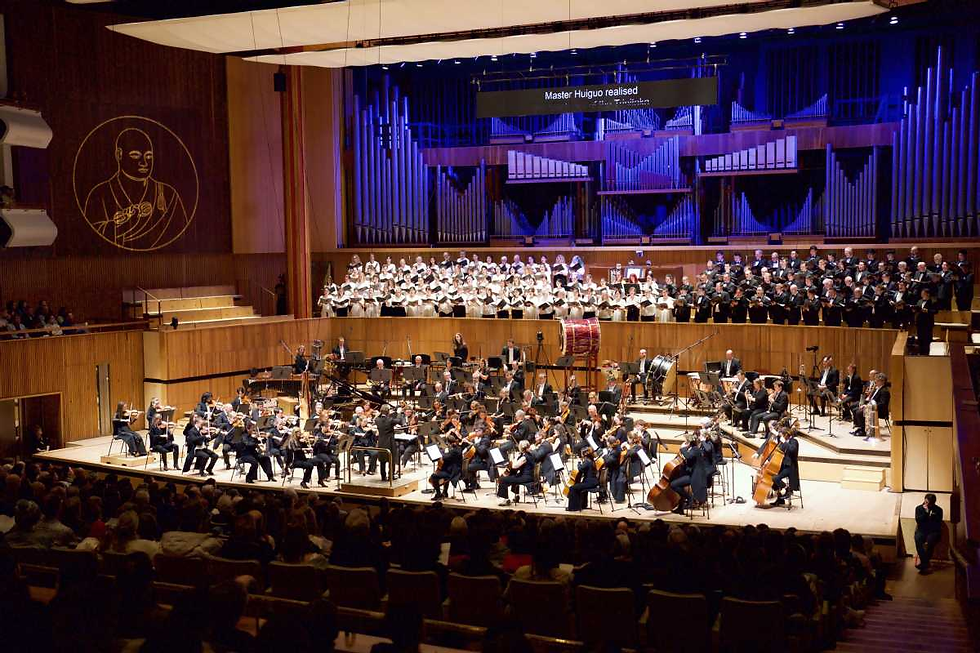
Radiance Across All Realms, Vows Without End | January 30th, 2026 | The London Philharmonic Orchestra Presents Symphony Kūkai At the Royal Festival Hall
In August 2024, the European premiere of the Symphony Kūkai was presented at Westminster Central Hall in London. That evening, on the north bank of the Thames, the ethereal and majestic harmonies from the East lingered long after the final notes faded, leaving an unforgettable impression upon all who attended.
A year and a half later, after touring Auckland, Osaka, and Kagawa, this work, which interweaves Kūkai’s compassion and wisdom through orchestral and choral language, has continued to evolve. It will incorporate the pipe organ for the first time and embark on a debut collaboration with one of the world’s leading orchestras, the London Philharmonic Orchestra. On January 30th, 2026, at the Royal Festival Hall on the South Bank of the Thames, a timeless dialogue between civilizations will once again be carried forward.


Symphony Kūkai commemorates the 1250th anniversary of the birth of the revered Buddhist monk Kūkai. Its narrative is drawn from the master’s extraordinary life: risking his life to cross the sea in search of truth, devoting himself to the welfare of all beings, and making boundless vows for the benefit of the world. The work vividly portrays Master Kūkai’s earnest pursuit of enlightenment, his treacherous voyage to Tang China, his inheritance of esoteric wisdom, his service as National Master under four Japanese emperors, and his lifelong dedication and compassion. Risking his life to cross the sea in pursuit of truth, Kūkai was met with Master Huiguo’s complete and selfless transmission of the Dharma, like one vessel pouring its every last drop of water into another. There was no trace of personal interest between them, but only a vast vow to benefit all beings. Their bond transcended language, ethnicity, and nation, moving generation after generation across a thousand years and becoming a luminous exemplar of cultural exchange in world history.
After returning to Japan, Kūkai devoted himself to fulfilling Master Huiguo’s earnest instruction to “let the Dharma flow throughout the world and increase the blessings of all beings”. Kūkai brought back an extensive array of advanced Tang-dynasty culture and technologies, promoting and applying them widely across Japan. His efforts not only established Buddhism in the Heian period but also influenced Japanese culture in countless ways.

Kūkai labored to establish Mount Koya and To-ji Temple as foundational centers of practice, where he taught the Dharma and ultimately became the National Master under four emperors. Today, both sites are recognized as UNESCO World Cultural Heritage locations. Kūkai founded Japan’s first school open to commoners, eliminating tuition and providing free room and board. The schools emphasized character education grounded in the teachings of Confucianism, Daoism, and Buddhism. Kūkai also oversaw the construction of the largest irrigation project in Japanese history, an endeavor that continues to nourish farmland and supply water to this day. He wrote extensively in poetry and prose, producing important literary works that preserved many Chinese literary theories later lost in China. He also played a role in the development of the Japanese written language, composing the Iroha poem as an introductory text for learning characters. Moreover, Kūkai influenced the aesthetic foundations of Japanese culture, including but not limited to the realms of calligraphy, painting, sculpture, and architecture, leaving behind national treasures with lasting significance.
Symphony Kūkai is a creation without historical parallel. Built upon the framework of Western symphonic tradition, it integrates East Asian tonal color and the contemplative aesthetics of Zen, weaving a musical tapestry that transcends cultures and eras. It pays heartfelt tribute to the great sages such as Master Huiguo and Master Kūkai, who dedicated themselves wholly to humanity with a spirit of complete altruism, surpassing all boundaries. It is their exalted spirits that cast a boundless radiance across human history, illuminating and warming the hearts of people in the past, present, and generations yet to come.
Since its premiere, Kūkai has been performed in eight cities around the world, including London, Tokyo, Auckland, and Osaka. Each performance has been met with overwhelming enthusiasm. Audiences of different nations and cultures found themselves connected through music in a single shared moment. This reaffirms our belief that Kūkai holds a power that transcends language, race, nationality, even faith, and reaches deep into the human spirit, awakening innate goodness and inner wisdom. In its atmosphere of tenderness, openness, and compassion, people rediscover resonance and mutual understanding. This is the vision of Kūkai: that listeners from all civilizations and languages may hear the compassionate and boundless vows of the master; that this sincere intention may warm more beings; and that the world may be gentler through understanding and kindness.

This performance marks the first collaboration between Kūkai and the London Philharmonic Orchestra. Founded in 1932 by Sir Thomas Beecham, the London Philharmonic Orchestra is world-renowned for its deep heritage, exceptional artistry, and adventurous programming. As the largest orchestra in the United Kingdom today, it stands as one of the great pillars of British symphonic tradition, honoring classical foundations while embracing a distinctly modern spirit, capable of both majestic grandeur and delicate lyricism.
Kūkai embraces a wide range of musical styles: at times vast and sky-reaching; at times intimate and poignant; moments of solemn hymnody soar beyond the clouds, while whispered Buddhist chants tremble through the earth. We believe the London Philharmonic Orchestra’s refined, balanced, and expressive musicianship will bring both the classical narrative depth and the modern emotional vitality of Kūkai to their fullest expression. Their encounter will reveal a profound unity of instrumental sound, vocal resonance, and inner spirit. Through every note, Kūkai’s boundless vow: “radiance across all realms, vows without end”, will be delivered to each listener.

The performance will be led by Maestro Takuo Yuasa, one of Japan’s most internationally influential conductors and Professor Emeritus at the Tokyo University of Arts, and also a musician whose life is deeply intertwined with Master Kūkai. Now in his seventies, Yuasa was born in the same year as New China, and on the same day as Master Kūkai; he grew up beside a temple that revered Master Kūkai and absorbed his stories since childhood.
Maestro Yuasa has long been active across the musical stages of Europe and America, collaborating with major orchestras worldwide. His relationship with the London Philharmonic Orchestra began in 1990, forming a friendship of more than three decades. Maestro Yuasa is celebrated for his expressive conducting and his passionate advocacy for contemporary music, navigating effortlessly between great symphonic classics and modern works. His career is defined by intellectual curiosity, clarity of interpretation, and heartfelt communication with musicians and audiences alike. His recordings have been praised by the Gramophone Magazine as “fresh and free of formula”, while MusicWeb International wrote that under his direction, the London Philharmonic Orchestra’s performances of Ravel, Sibelius, and Debussy “radiated astonishing freshness and originality.”
The chorus for this performance will be presented as a collaboration between the China Central Conservatory of Music Choir and the London Philharmonic Choir. Both ensembles are distinguished for their world-class balance, tonal richness, and expressive depth. When the meditative purity of an Eastern choir intertwines with the solemn grandeur of a Western one, their blended voices rise toward the vaults of the hall, creating a transcendent power that bridges cultures and moves the soul.
Notably, the performance will take place at London’s Royal Festival Hall, the iconic concert hall of the Southbank Centre. Its modern acoustics and expansive stage offer an ideal home for this symphonic monument. The Royal Festival Hall renders every orchestral detail with clarity, while preserving the music’s depth and resonance in its most powerful passages. For this performance, Kūkai will present newly revised lyrics and music, as well as the first inclusion of the pipe organ in its international tour, introducing a distinctive sonic dimension within this renowned hall.

As singer Hayley Westenra remarked after listening to the symphony: “My heart was opened. I felt filled with inspiration. This is truly an opportunity that uplifts and enlightens the spirit.”
On January 30th, 2026, at London’s Royal Festival Hall, we invite you to witness Kūkai — its radiance unbound and its vows without an end.